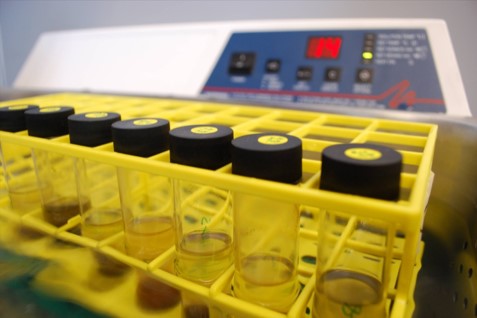
After discussing your project questions and requirements, we proceed with analysis of the sherds once they arrive at our Bristol laboratories. Our technicians clean, sample, and crush a small portion of each sherd (c. 2g) before undertaking solvent-based lipid extraction. The extracts are analysed using gas chromatography (GC-FID) to gain a preliminary understanding of lipid profile and concentration. Based on these results, selected extracts are then analysed by GC with mass spectrometry (GC-MS) and compound-specific stable carbon isotope ratio mass spectrometry (GC-c-IRMS), to confirm the molecular composition and determine stable isotope values of individual fatty acids, respectively. This provides us with the molecular and isotopic fingerprints to characterise the source(s) of the residues – for instance, animal meat and milk, plant waxes and resins. We also explore the presence of aquatic biomarkers, including long-chain (alkylphenyl) alkanoic acids. Finally, we provide you with a report interpreting this data and are happy to talk this through with you.
Although the majority of analyses are carried out on pot sherds, we are also able to work with a variety of other materials, such as soil samples, carbonised residues and burnt flint.
If you are considering a project which would benefit from these techniques, do feel free to contact us for no-obligation information regarding current costs and lead times. We can also advise on project design to help address your research questions.
The AHRC RICHeS Access fund is available to support projects for UK-based users.
 Organic Residue Analysis